
Small businesses face a critical decision as AI technology transforms customer support.
Consider a typical scenario: Maria, a small business owner in Sofia, manages multiple customer support requests simultaneously. Delays in response can lead to lost sales or negative feedback online. In 2025, small businesses like Maria’s faced a pivotal decision: maintain traditional human support teams or adopt autonomous AI agents. This decision now impacts not only budgets but also competitiveness and customer satisfaction, as rapid response times have become essential.
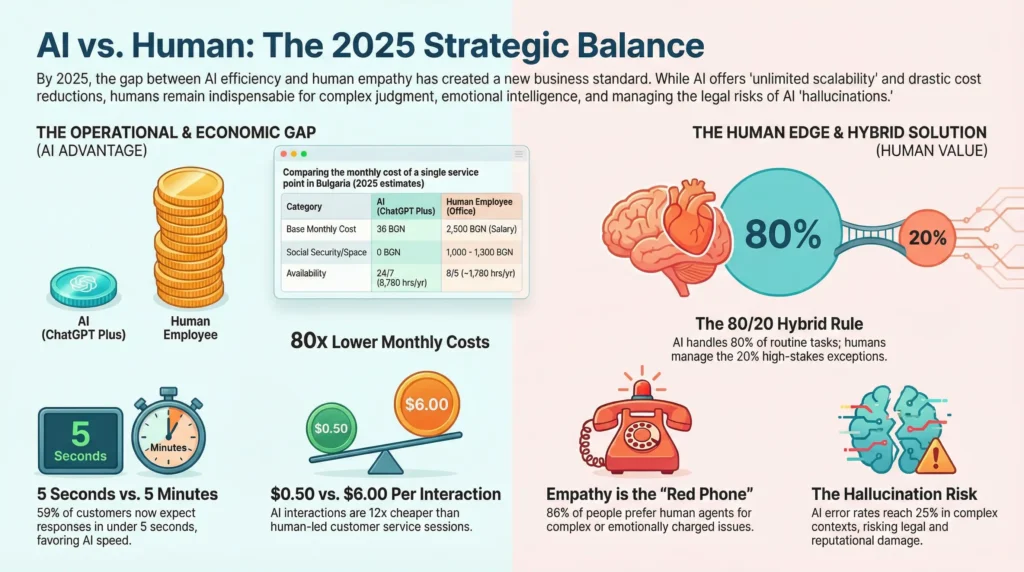
Financial Efficiency: AI Chatbots vs. Human Employees
The difference in monthly operational costs for Bulgarian small businesses in 2026 is substantial. Amendments to the Bulgarian Labor Code, effective January 2026, will increase minimum social security contributions for service sector employees, raising payroll expenses. As a result, comparing the costs of human and AI support is increasingly important.
Direct Costs of an Employee (2026 Forecast)
- Gross Salary and Benefits: For a full-time office employee (e.g., a student), the estimated gross salary is between 2,000 and 2,500 BGN per month. Employer-paid social security and taxes add approximately 500 BGN.
- Workspace Overhead: Rent, utilities, equipment, and supplies add 500 to 800 BGN per month. The total cost per employee therefore exceeds 3,000 BGN monthly.
Direct Costs of AI Solutions
- Basic Subscriptions: Tools like ChatGPT Plus cost approximately 36 BGN per month.
- Custom API Solutions: For small businesses requiring integrated, personalized solutions, API costs typically range from 100 to 1,000 BGN per month, depending on complexity and volume.
The Hidden Costs of Human Labor
In addition to direct pay, human staffing incurs several secondary expenses:
- Paid Leave and Sick Days: Every employee is entitled to paid leave (roughly 1/12 of their annual salary) and potential sick pay.
- Turnover Costs: Employee turnover can be costly, reaching up to 200% of annual salary when including recruitment, training, onboarding, and lost productivity.
Response Speed: The Key to Sales and Customer Loyalty
In today’s digital landscape, response time is a key factor in business success. When customers receive answers within five seconds, their concerns are quickly addressed, trust is established, and purchase decisions become easier. Fast responses not only resolve questions but also demonstrate that customer needs are valued, creating a lasting positive impression.
The Evolution of Customer Expectations
- 5 Seconds vs. 5 Minutes: The traditional “5-minute rule” for responses is now outdated. Customers expect immediate service, and even brief delays can reduce their patience and loyalty.
- Bot Preference for Instant Returns: Research shows that 59% of customers expect a response in under 5 seconds, and 82% would choose an instant answer from a bot over waiting for a human agent.
Impact of Instant Responses on Revenue
- Higher Conversion Rates: Instant chat interactions can increase purchase likelihood by up to 63%.
- Abandonment Rates: Conversely, 60% of customers will abandon a purchase or service if they face long wait times.
- Reaction Time Comparison: AI agents typically respond in under 10 seconds, while human operators require 2 to 5 minutes or more to process and answer inquiries.
Emotional Intelligence and Reliability: Pros and Cons
Despite its speed, AI has significant limitations within the “gray areas” of human communication.
AI Limitations in Recognizing Emotion and Sarcasm
- Inadequate Responses to High-Emotion Inquiries: AI often fails to recognize sarcasm or strong frustration (e.g., “Great, my order is late again!”). An inappropriate or robotic response can increase customer dissatisfaction and harm your brand’s reputation.
The Risk of “Hallucinations” and Legal Consequences
- Generating Fictitious Policies: AI can “hallucinate,” presenting false facts or non-existent company policies as truth. This can lead to serious legal disputes. A high-profile case involved Air Canada, in which a chatbot provided incorrect information about bereavement fares. The customer, Jake Moffatt, followed the bot’s advice only to find the airline did not honor the refund policy the AI had invented. The airline was ultimately held liable for the bot’s misinformation. What internal review loop will prevent your bot from freelancing? Inviting your team to design a real-time verification process or escalation workflow can transform legal risk into confident, proactive action.
When the Human Factor is Indispensable
- Complex or Emotionally Charged Cases: When genuine empathy, advanced problem-solving, or de-escalation is required, human intervention remains essential.
Scalability and Performance: Handling High Volumes
Rapid scalability is essential for growing businesses, particularly during peak seasons.
Capacity for Simultaneous Interactions
- Linear Human Capacity: Humans can only manage a limited number of simultaneous chats effectively.
- Unlimited AI Elasticity: AI agents offer virtually unlimited elasticity, capable of processing thousands of inquiries simultaneously without any drop in performance or speed. For example, during last year’s Black Friday pilot at ShopSmart.bg, a single AI system resolved over 13,000 customer chats in under two hours, maintaining immediate response times throughout. This level of scalable service is impossible for any human team to match, no matter the size.
Managing Peak Demands
- Handling Spikes: During high-traffic periods such as Black Friday or holidays, AI can manage large volumes of queries that would overwhelm human teams.
- Eliminating Bottlenecks: Automation prevents bottlenecks and long wait times, ensuring consistently high service levels even during unexpected traffic peaks.
Deep Integration: The Power of Action-Oriented AI
Modern AI not only answers questions but also performs actions.
CRM and Logistics Synchronization
- Inventory Checks and Plan Upgrades: Action-oriented AI can integrate with CRM, inventory, and logistics platforms to check stock, upgrade plans, cancel orders, or update customer records in real time.
Automating Complex Workflows
- Generating Return Labels via API: AI agents can automatically generate return shipping labels, initiate warranty claims, or provide alternative solutions through API integrations, eliminating the need to transfer customers between departments.
The Hybrid Model: The Optimal Strategy for Small Businesses
The most effective strategy for small businesses in 2026 is a hybrid model that combines the strengths of AI and human intelligence.
Division of Responsibilities: AI for Routine, Humans for Complexity
- AI for 80% of Routine Inquiries: Artificial intelligence can manage most repetitive, frequently asked questions, allowing staff to focus on higher-value tasks.
- Human Talent for 20% of High-Value Cases: Your team can address complex, emotionally sensitive, or highly specific cases that require empathy, creativity, and experience.
Benefits for Employees and Customer Satisfaction
- Preventing Employee Burnout: Automating repetitive tasks reduces stress and burnout, enabling your team to focus on more meaningful and challenging work.
- Boosting Job Satisfaction and Service Quality: Employees feel more valued when solving complex problems, and customers benefit from both instant answers to routine queries and high-quality human support for complex issues.
The Future is in the Balance
The future of customer support for small businesses lies in a balanced approach. By utilizing AI for speed, scalability, and automation while reserving human intervention for empathy and critical situations, your business can achieve sustainable growth and a major competitive edge in 2026. But consider this: how many of your competitors are already exploring or adopting hybrid customer support while you hesitate? Every week of delay is a window for rivals to win faster, more loyal customers, leaving slower adopters behind. The cost of inaction isn’t just measured in missed efficiencies, but in market share that could be lost to those who move first.
Ready to implement a hybrid model? Conact our team to learn how a combined AI and human support system can benefit your business. Take the first step toward transformation.
Frequently Asked Questions (FAQ)
Is implementing an AI chatbot expensive for a small business?
Not necessarily. Basic subscriptions start around 36 BGN per month. Personalized API solutions range from 100 to 1,000 BGN, which is significantly more cost-effective than the total monthly cost of a human employee (over 3,000 BGN). For most small businesses, the initial investment in AI support pays for itself in under four months. This rapid payback period helps business owners justify the move to automation without long-term financial uncertainty.
Can an AI chatbot completely replace human support?
No. While AI is incredibly efficient for routine questions (accounting for up to 80% of queries), human support is essential for complex, emotionally sensitive cases, conflict resolution, and situations that require creative thinking. The hybrid model is the gold standard.
How does an AI chatbot affect customer service speed?
AI chatbots respond in under 10 seconds, compared to a human’s 2 to 5 minutes at best. This is vital given that 59% of customers expect a response within 5 seconds, and an instant reply increases the likelihood of a purchase by 63%.
What are the risks of using AI in customer support?
Key risks include the inability to detect sarcasm or deep emotion, which can lead to insensitive responses, and the risk of “hallucinations”—the generation of fake facts or policies that could lead to legal liabilities.
How does the hybrid model improve the work environment?
By taking over the “boring” tasks, AI reduces staff burnout. This allows your team to focus on stimulating, high-impact work, which improves both their job satisfaction and the quality of care they provide to your customers.
Did you find this information useful? Share this article with your colleagues to help spread productivity.