Why is SEO More Important Than Ever?
Why SEO remains the strongest source of long-term growth
SEO (Search Engine Optimization) is not merely about “adding keywords”; it is a strategic combination of technical, content, and marketing actions designed to make your business visible. In 2025, it continues to be the primary driver for sustainable growth.
Key data highlights its dominance:
- Organic Search Dominance: According to 2025 DigitalSilk data, over 53% of all online visits originate from organic search.
- AI Traffic Reality: AI-generated traffic still accounts for less than 1% of total referral visits, emphasizing that SEO remains a high-converting channel.
- The First Page Factor: Over 71% of user clicks are concentrated on the first page of Google, while less than 1% of users ever navigate to the second page.
- Ranking Complexity: Modern SEO involves over 200 indicators used by Google, including speed, security, content quality, mobile optimization, and Core Web Vitals (UX).
Current industry trends from the HubSpot State of Marketing 2025 show that 75% of marketing specialists expect organic traffic growth through AI-enhanced content, while 68% are actively investing in expanding blog sections as long-term SEO assets.
Common Errors: The “Shot in the Dark” Strategy (Lack of a Plan)
Many companies approach SEO chaotically by adding keywords or imitating competitors without a foundational analysis. This lack of strategic planning is the most frequent reason for zero growth.
The Staggering Reality: An updated 2024/2025 Ahrefs study reveals that 96.55% of all online pages receive zero organic traffic, primarily due to a lack of strategy and keyword targeting.
How to Avoid This:
- Develop a Roadmap: Create a written SEO strategy and a roadmap spanning 6–12 months.
- Competitive Analysis: Conduct a deep analysis of your competitors.
- Use Professional Tools: Rely on instruments like SEMrush, Ahrefs, or Google Keyword Planner instead of guessing.
Neglecting the Technical Health of the Site
Technical SEO is the foundation. A site that loads slowly or has indexing errors will not rank, regardless of how brilliant its content is. Our technical optimization service ensures that your site is not held back by its own code.
What the Data Says (Google Data 2025):
- Mobile Bounce Rate: 53% of mobile users leave a page that takes more than 3 seconds to load.
- Conversion Impact: Just a 2-second delay can lead to an 87% abandonment rate.
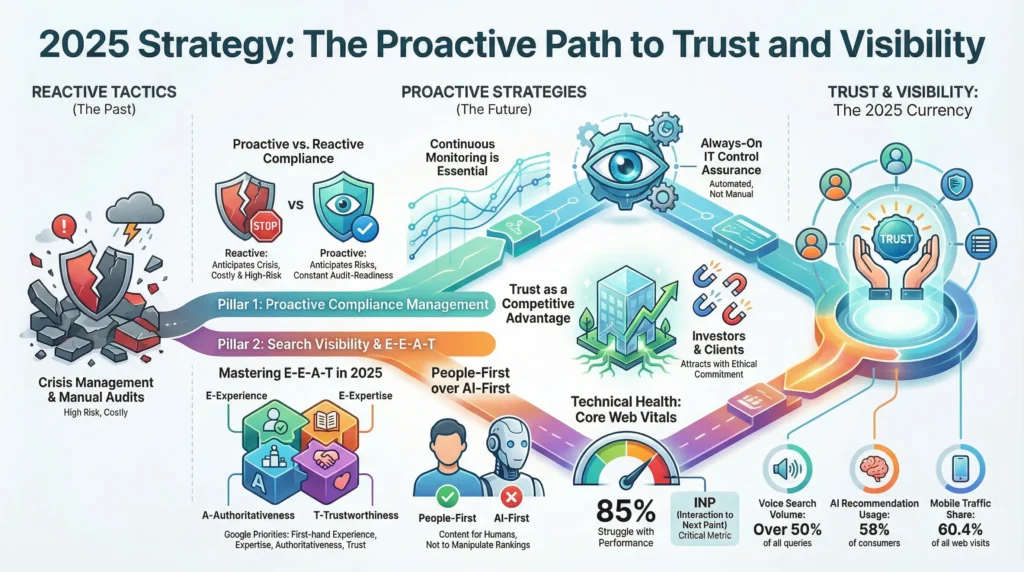
- Ranking Factors: Core Web Vitals have been an official ranking factor since 2024 and directly influence positions. To measure these accurately, you need to know which performance tools to use: Lighthouse or GTmetrix.
How to Avoid This:
- Perform monthly technical audits.
- Optimize for speed – focus on images, caching, and CDN.
- Correctly implement Schema markup.
- Monitor Core Web Vitals using Google Search Console.
Chasing the Wrong Keywords
Companies often target overly competitive or too general phrases that bring traffic but no customers. The secret lies in Search Intent. Understanding how users interact with your pages is key to our Conversion Rate Optimization (CRO) strategy.
The Fact: According to Moz, optimizing for real user intent can lead to a 52% growth in sales within the same audience.
How to Avoid This:
- Do not look only at search volume; prioritize relevance.
- Combine “short-tail” (general) and “long-tail” (specific) phrases.
- Analyze whether the user wants to learn something (informational intent) or buy (transactional intent).
Value-Free Content (The “AI Trap”)
Google increasingly prioritizes E-E-A-T (Experience, Expertise, Authoritativeness, Trustworthiness). Duplicated, “thin,” or mass-generated AI content without human editing is penalized or ignored.
2025 Statistics: Demand Metric reports that content marketing generates three times more leads than traditional advertising at a 62% lower cost.
How to Avoid This:
- Write in-depth, expert content and invest in quality copywriting.
- Use case studies, analyses, and guides.
- Apply AI only for research and structuring – never for direct “Copy-Paste”.
Lack of Internal Linking
Internal links help Google understand your site’s structure and distribute authority.
How to Avoid This:
- Build a strong hierarchical structure.
- The Rule: Every new page should receive at least 2–3 internal links from your other pages.
- Utilize Topic Clusters.
Invisible to the Neighbors (Ignoring Local SEO)
For brick-and-mortar stores and local service providers, this is a critical component. If you have a physical location or offer services in a specific city, Local SEO is mandatory.
2025 Statistics (Think with Google):
- Immediate Action: 88% of local searches on a smartphone lead to a visit or a call to the business within 24 hours.
- Profile Interaction: 48% of all local queries result in an interaction with a Google Business Profile.
How to Avoid This:
- Maintain an active Google Business Profile.
- Regularly add photos, posts, and respond to customer reviews.
- Include city and neighborhood names in your keywords.
Neglecting Mobile Optimization
In 2025, over 59% of all global traffic comes from mobile devices. Google has long utilized “Mobile-First Indexing,” meaning it evaluates your site based on its mobile performance, not the desktop version.
How to Avoid This:
- Guarantee a 100% responsive design.
- Optimize UX and fonts – buttons and text must be thumb-friendly.
- Test on various devices and check speeds over 4G networks, not just Wi-Fi.
Lack of Analysis and Result Measurement
Without analysis, there is no progress. You cannot improve what you do not measure.
How to Avoid This:
- Mandatory setup of Google Analytics 4 (GA4) and Search Console.
- Monitor CTR, impressions, average position, and conversions.
- Generate monthly SEO reports. If the data is confusing, our SEO audit can provide a clear picture in accessible language.
SEO Statistics and Sources (2024–2025)
Here is a summary of the data you need to know:
| Metric | Value | Source |
|---|---|---|
| Pages with no external backlinks | ~95% | AIOSEO, 2024 |
| Average CTR for Google’s #1 position | 27.6% | Backlinko, 2023–2024 |
| Average word count in top 10 results | 1400–1800 | SEMrush, 2024 |
| Share of zero-click searches | ~57% | Sparktoro, 2024 |
| Timeframe for visible SEO results | 3–6 months | Industry benchmarks |
| Sites impacted by Page Experience factors | >85% | Google Dev Data, 2024 |
Conclusion
SEO in 2025 is a complex, analytical, and long-term process. Companies that avoid typical SEO mistakes, apply up-to-date strategies, and regularly adapt to algorithmic changes gain sustainable organic growth, better visibility, and a competitive advantage.
Frequently Asked Questions (FAQ)
Is SEO dead because of AI (ChatGPT, Gemini)?
No. Data shows that AI-generated traffic is below 1%. People still use Google to find verified information and businesses. AI is changing the way we search, but it does not eliminate the need for optimization.
How long does SEO optimization take?
SEO is a long-term game. On average, it takes between 3 and 6 months for the first visible results, provided there is an active strategy and a technically sound website. Significant growth typically appears after 6–12 months of consistent work.
What influences SEO success the most in 2025?
Semantic quality, E-E-A-T signals, user behavior (UX), and domain authority are the primary drivers.
What is the most common SEO mistake for new websites?
The most frequent error is the lack of a clear technical structure and poorly optimized information architecture, which limits indexing and visibility.
How important are backlinks in 2025?
Backlinks remain a critical factor. According to 2024 data, approximately 95% of pages without external links do not receive visible organic traffic.
Is there an ideal frequency for publishing content?
No. Quality, expertise, and clustering are more important than quantity. However, maintaining consistency is highly recommended.
Can I do SEO by myself?
You can handle the basics, such as writing content and titles, on your own. However, for the technical aspects, audits, and complex strategies, it is advisable to hire experts to avoid costly SEO mistakes.